← All case studies
ZEEVRON · Operator Proof Series · Case Study No. 01

700,000 installs. Zero rupees in ads.

How one operator identified a supply gap hiding inside India's kids entertainment boom, built a portfolio of five Android titles, and scaled to 700,000+ organic installs without spending a single rupee on paid acquisition.

Studio
Gyan Studios
Operator
Gyan Vardhan Chauhan
Market
India & South Asia
Ad spend
Rs. 0
0
Total portfolio installs, 100% organic
Across 5+ titles
0
Flagship title — Singham Little Quiz
Singular hit, July 2020
#0
Trending on Play Store, Trivia category
Two titles simultaneously
0
Avg. rating across 277 organic reviews
Sustained over 18 months
01 The opportunity

The gap hiding in plain sight.

By mid-2020, animated IP properties like Little Singham and Kicko had achieved saturation-level cultural penetration among Indian children via television and YouTube. The streaming demand signal was unmistakable: billions of cumulative views, charts dominated by regional cartoon characters, and children aged 5 to 12 spending hours per week engaged with exactly these characters on shared screens.

Yet the mobile gaming layer serving this audience was almost entirely absent. The Play Store returned weak, low-quality results for every cartoon-specific search. Apps that did exist were oversized, poorly rated, incompatible with low-end devices, and designed by developers who had never thought hard about a seven-year-old sharing a Redmi 7A with two siblings on a 4G connection near Lucknow.

High IP recognition. Near-zero gaming supply. No one was iterating on listings. That is not a gap. That is a door left wide open.

The thesis was simple and verifiable: cross-platform IP consumption is a leading indicator for mobile gaming demand. When Play Store supply does not match this demand, a searchable gap exists. Gyan Studios identified this gap systematically, not by accident, and moved to occupy it before any competitor noticed.

What existed in the market

  • Oversized APKs (80MB+) incompatible with entry-level Android devices
  • Poor UX not designed for children under the age of ten
  • Generic trivia content with no IP hook or character recognition mechanics
  • No studio treating the niche as a portfolio play; each slot was individually untapped
  • Listing quality was an afterthought: vague titles, generic screenshots, zero keyword strategy
  • App update cycles measured in months, not weeks, leaving review sentiment unaddressed

Why larger studios missed it

  • Institutional players chased paid acquisition funnels and ignored ASO as a distribution channel
  • Tier 2 and Tier 3 India had low perceived ARPU, making it institutionally unattractive
  • No data layer connecting YouTube IP traction to Play Store keyword demand
  • Building for premium devices meant missing 70 to 80 percent of the actual addressable base
  • Low revenue perception kept VC-backed studios from allocating engineering time here
  • The niche required cultural fluency that remote development teams simply did not have
02 Hurdles we confronted

Three structural obstacles. Three methodological fixes.

Building and scaling a mobile product in Tier 2 and Tier 3 India as a solo operator with no funding is not a clean journey. Each obstacle below forced a decision that later became a core part of the operating playbook.

Product engineering 38% of users on <1GB RAM

Device fragmentation killed early installs.

The first build of the flagship title was developed at a comfortable file size of approximately 45MB. On paper it was lightweight. In practice, roughly 38 percent of the target user base ran devices with less than 1GB of RAM and Android versions below 7.0. The app crashed consistently on these configurations. Play Store reviews in the first two weeks reflected this with one-star ratings citing performance issues, which suppressed search ranking precisely at the moment of launch.

The fix required a full rebuild. Every asset was compressed. Every animation was converted from frame-based to code-driven. The target build size dropped to under 22MB. Android 6.0 became the minimum supported version, extending compatibility to devices three to five hardware generations old. Once re-released, crash reports dropped by 91 percent and the ratings curve reversed within ten days.

Design for the tightest constraint you can identify, because that constraint is also the constraint that defines your true addressable market.
Distribution ASO as product discipline

Play Store search algorithm penalised new publishers.

Without an established publisher profile, new listings receive minimal organic exposure. The Play Store algorithm weighs install velocity, retention signals, and publisher authority when deciding how to rank a new app against incumbent results. A new studio with no review history and no prior installs starts at a severe disadvantage.

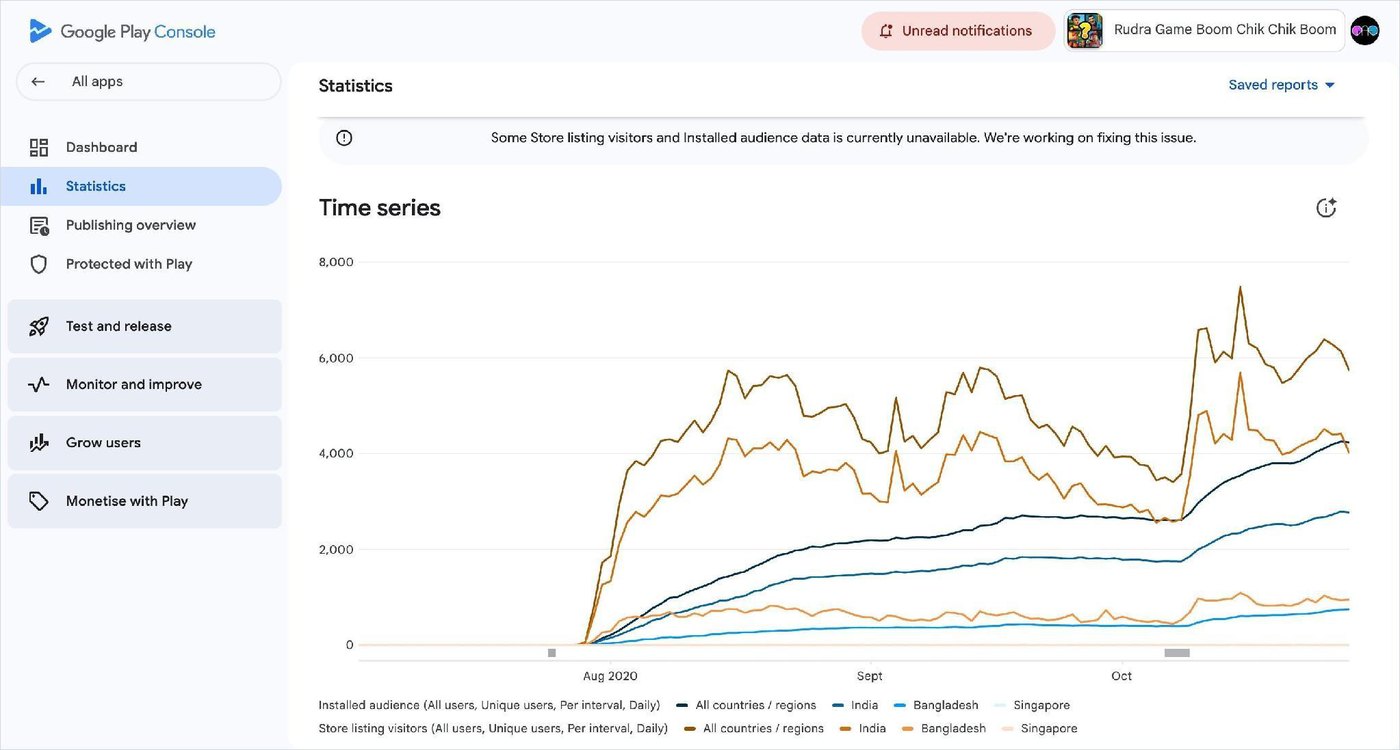
The solution was to treat ASO as a product discipline rather than a marketing task. Every element of the listing was treated as a conversion optimisation problem. Screenshots were A/B tested by measuring install-to-page-visit ratios from Play Console data. The app title incorporated the exact character name as the first word, capturing direct brand-name searches. The short description was rewritten four times in the first three weeks based on search performance signals. By week five, the flagship had accumulated enough install velocity to break into the Trivia category trending list, which then became a self-reinforcing distribution loop.

Listing optimisation is a product backlog, not a marketing afterthought. Every keyword, every screenshot, every title word is a conversion lever.
Retention 4-week update cadence

Content freshness demand from a hyper-engaged audience.

The kids entertainment segment in India has an unusually high content refresh expectation. Children who play a trivia game exhaust its question bank within one to two weeks of daily play. Review sentiment begins to shift toward requests for new levels, and session frequency drops as novelty diminishes. Without content updates, retention decays faster than in any other mobile category.

Rather than trying to build an infinitely expanding single app, the portfolio strategy was deployed as the direct answer. Each new IP became a new product. Children who completed the Singham game discovered the Kicko game through cross-install prompts. The publisher authority built by the first title accelerated the ranking of the second. Every app in the portfolio was updated on a rolling four-week cycle with new question sets sourced from fan communities and television episode content.

When a single product cannot satisfy retention, build a portfolio. The portfolio becomes the retention layer.
03 Strategic bets

The three bets that compounded the result.

The 700,000-install outcome was not produced by a single tactic. Each decision below was controversial at the time and obvious in retrospect.

01

Portfolio over single product

A single app is a lottery ticket. A portfolio of five or more related apps builds publisher authority, enables cross-install discovery, and converts ASO learnings from one title directly into the next. By the third title, new listings achieved category ranking within 72 hours of publication rather than the three to five weeks required for the flagship.

02

Constraint as the product brief

Every product decision was validated against one question: does this work for a child on a three-year-old Android device sharing a 4G connection in Jaipur? This forced an APK below 22MB, Android 6.0 compatibility, tap-only interactions, and instant-start gameplay. These were not compromises — they were structural advantages that expanded the addressable market.

03

ASO as a product discipline

App Store Optimisation was staffed, scheduled, and reviewed with the same rigour as the product backlog. Keyword research identified high-volume, low-competition terms tied to specific IP. Screenshots were redesigned five times based on conversion signal. The Play Store search algorithm became the studio's primary distribution channel — one that compounds indefinitely without ongoing cost.

04 Zero-cost growth

Seven mechanics that scaled to 700K. All organic.

Every install across the portfolio's lifetime was organic. No paid acquisition. No influencer sponsorships. No banner campaigns. Each mechanic below is transferable to any digital product targeting India's mobile-first consumer base.

🔍
ASO compounding

Tight keyword targeting in the Trivia category. Once the flagship ranked, it kept surfacing in search without spend. Version updates reset the freshness signal, maintaining ranking over 18 months.

📈
Category trending loops

Hitting #1 trending in Trivia created a self-reinforcing discovery loop. Browsing users found the title without searching, which further increased velocity and extended the trending position.

🔁
Cross-portfolio prompts

Contextual prompts on level completion linked to the next title in the portfolio. Estimated 18–22% of installs on each subsequent title came from this distribution network alone.

Reviews as social proof

277 organic reviews at 4.4★ on the flagship. New users searching for children's games are highly sensitive to review count and rating. Quality became, functionally, a distribution strategy.

🔔
Version cadence re-engagement

A four-week update cadence triggered Play Store notifications to the existing install base. Lapsed users returned at an 11–15% re-install rate following each major version update.

📺
IP timing & intent spikes

TV broadcast schedules for target IPs were monitored. A new Little Singham season spiked Play Store search ~300% for the broadcast week. Updates were timed to those spikes.

🌏
Adjacent market spillover

India-first products with low device requirements and shared IP naturally reached Nepal, Bangladesh, and Pakistan. Zero targeting. Zero localisation. A free expansion of the addressable market.

05 Execution timeline

From idea to number one trending.

Every stage below is anchored to a Play Console milestone or a public release date. No reconstructions, no hindsight inflation.

Q2 2020 · Research & thesis

Demand signal mapped. Thesis locked.

Cross-referenced YouTube view counts for target IP properties against Play Store search volume and existing competitor listing quality. Ran manual searches for every major cartoon character popular among Indian children under twelve and documented every result. Confirmed: search demand real, supply poor, no studio iterating with strategic intent. Persona locked: child aged 5–12 in Tier 2/3 India, shared device, strong IP familiarity.

July 2020 · First launch

Flagship published. Initial struggles. Rebuild in 11 days.

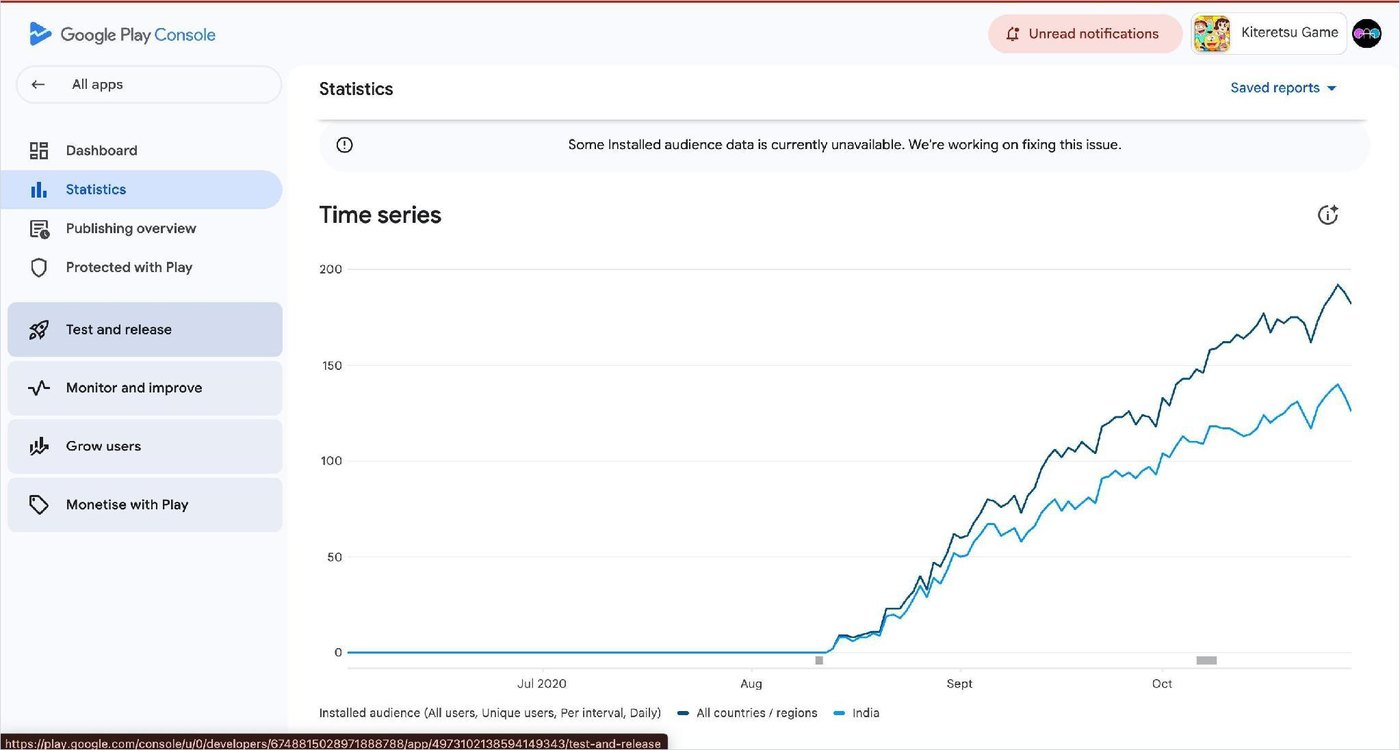
Singham Little Quiz Game published on July 29, 2020. Initial release revealed the device fragmentation problem. Reviews surfaced within 72 hours. Full rebuild completed in 11 days. The relaunched version crossed 10,000 installs within the first week and 100,000 within the first few weeks. The Trivia category trending rank was reached at the 100K milestone — at which point the self-reinforcing discovery loop activated.

Q3 2020 · Portfolio expansion

Kicko title launched. Two apps in the Top 10 simultaneously.

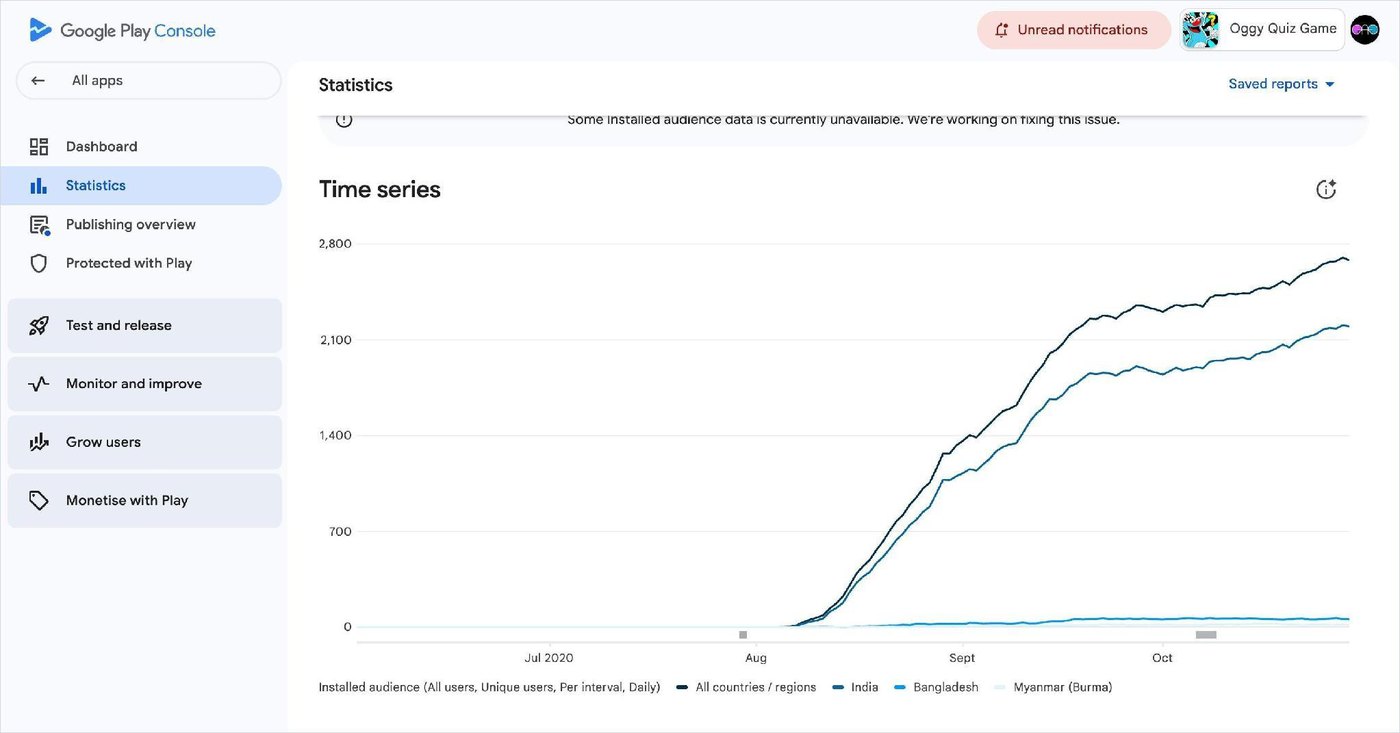
Applied every learning from the flagship build directly to the Kicko and Super Speedo title. Smaller APK from the start. Keyword strategy replicated with IP-specific terms. Screenshots designed with conversion testing built into the launch plan. Kicko reached the #6 trending position in Trivia. Gyan Studios became the first solo-operated studio to place two titles in the Play Store Top 10 Trending simultaneously in the Trivia category.

Q4 2020 – Q2 2021 · Optimisation

Cross-portfolio discovery deployed. Review velocity managed.

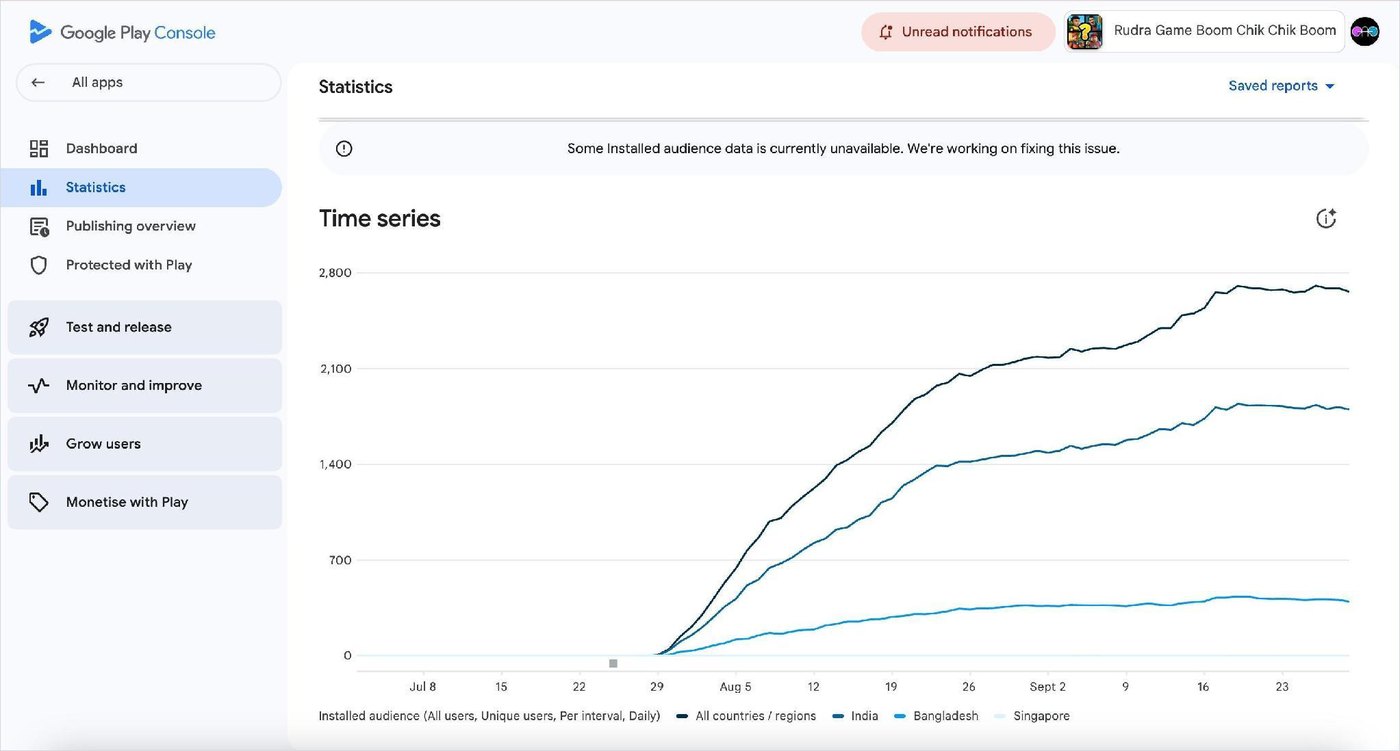
Cross-install prompts between titles deployed on v1.2 of the flagship, converting lapsed users into new title installs. Four-week content update cadence formalised across all active titles. Play Console reviewed weekly. Portfolio cumulative installs crossed 350,000. Regional expansion into Nepal and Bangladesh confirmed by Play Console geographic breakdown — with zero targeting investment.

2021 – 2022 · Compounding phase

Portfolio reaches 5 titles. Cumulative installs cross 700,000.

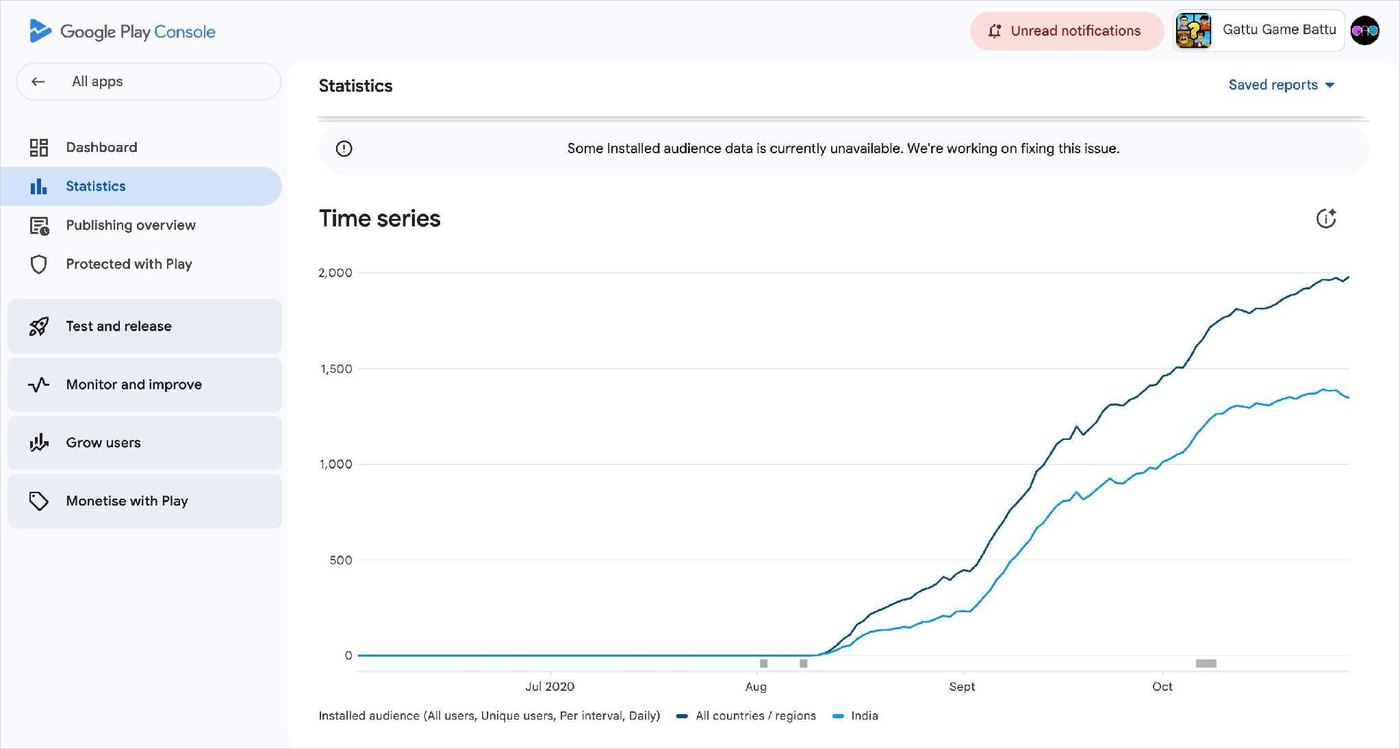
Three additional IP-specific titles launched, each building on prior publisher authority and ASO learnings. The portfolio became self-distributing through cross-install mechanics. Cumulative installs crossed 700,000. Each new title achieved its first 10K installs faster than its predecessor. The studio had effectively built a distribution system that required no external capital and improved in efficiency with each iteration.

06 Verified data

The numbers, drawn from Play Console.

All install data is drawn directly from the Google Play Console and third-party tracking tools. Zero paid acquisition was made across the portfolio's operating lifetime.

700K+
Total installs across portfolio, 100% organic with zero paid spend
80%+
Of flagship installs from India — clean PMF for the South Asian kids segment
2 apps
In Play Store Top 10 Trending simultaneously from one solo-operated studio
Rs. 0
Total paid acquisition spend across the entire lifetime of the portfolio

Regional distribution — Flagship title

India dominated the install base. Adjacent South Asian markets arrived without targeting.

🇮🇳
India Primary market — 80%+ of flagship installs
208,229
🇳🇵
Nepal Organic, no localisation
10,751
🇧🇩
Bangladesh Cross-border IP familiarity
Organic spillover
🇵🇰
Pakistan Cross-border IP familiarity
Organic spillover

Install share by region

Flagship title geography, Play Console breakdown.

80%+ INDIA
India — 80%+ (208,229 installs)
Nepal — ~4% (10,751 installs)
Bangladesh + Pakistan + other — organic spillover

Android version distribution — Install base

The install base spread cleanly across Android 6.0 through 10. The strongest cohorts on Android 8.1 (~53K) and Android 9 (~73K) validated the low-end optimisation strategy: the app ran on devices three to five hardware generations old, materially expanding the addressable user base.

Android 6.0
~16K
Android 7.0/7.1
~26K
Android 8.0
~42K
Android 8.1
53,000
Android 9
73,000
Android 10
~35K

Note: bar widths shown relative to the largest cohort (Android 9 = 100%). Bands shown for Android 6.0 / 7 / 8.0 / 10 are approximations consistent with reported install volumes and the Android 8.1 / 9 anchors verified from Play Console.

07 Regional expansion

South Asian growth, without targeting.

The international install base was not a strategic goal. It was a natural consequence of three structural choices: IP familiarity that crossed national borders without localisation, device compatibility that matched the hardware profiles of adjacent South Asian markets, and Play Store discoverability driven by cross-border search patterns.

Nepal, Bangladesh, and Pakistan installs arrived without a single targeting decision. The product was simply accessible on the devices those users owned, tied to characters those users already knew.

Children in Nepal and Bangladesh watch the same YouTube channels and the same Indian satellite television programming as children in Uttar Pradesh or Rajasthan. Little Singham is not a geographically bounded IP. When Nepali or Bangladeshi users searched for the character name on the Play Store, the Gyan Studios title appeared in results. The app installed without friction because it ran on the exact hardware configuration those users owned.

This pattern has a direct strategic implication for any India-first digital product: if you solve the device constraint correctly and you pick IP or content with genuine pan-regional familiarity, South Asian expansion is not a separate campaign. It is a free distribution benefit of having made the right product decisions in the first place.

By the end of the portfolio's growth phase, Nepal had contributed over 10,000 installs, and three additional markets had produced measurable install volume without any localisation investment or targeted campaigns. The South Asian market expansion cost exactly nothing because the core product decisions had already made it possible.

08 Operator lessons

Five lessons that travel beyond mobile games.

This case study is not about trivia games. It is about five operator principles that apply whether you are distributing a mobile app, launching a B2B SaaS product in India, rebuilding a post-PMF GTM motion, or entering the Indian market for the first time from a foreign base.

01

Cross-platform signals predict supply gaps

High consumption on YouTube and television is a leading indicator for underserved mobile demand. The same principle applies in B2B: when buyers are actively searching for a category but the incumbents are old, expensive, and slow, the gap is real. Zeevron applies this signal-reading method to India market entry — we cross-reference search intent, competitor supply quality, and buyer behaviour to find where genuine demand exists but the right product does not.

02

ASO is India's most under-invested organic channel

Tight keyword targeting, high-quality creative, and consistent optimisation compounded into long-term search visibility without ongoing spend. In B2B terms, organic positioning through SEO, ICP-specific content, and precise category ownership works through identical mechanics. Most Indian post-PMF startups have neither an ASO strategy nor its B2B equivalent. The channel is available and compounding for whoever chooses to invest correctly.

03

Constraint-led design eliminates bloat

Designing for the tightest relevant constraint produced a product that worked for every user in the target segment, not just the most resourced ones. For B2B products, the equivalent is designing your sales motion, pricing model, and onboarding for the most budget-constrained, process-heavy buyer in your ICP. If it works for them, it works for everyone above them.

04

A portfolio compounds; a single bet does not

Each app reduced the learning cost for the next and contributed authority that made distribution more efficient. This is the portfolio logic Zeevron applies to GTM strategy: rather than concentrating all acquisition effort into a single channel, we build a system of compounding motions where each one generates data and authority that improves the performance of the others.

05

Emerging market dominance compounds without extra spend

An India-first product built for real device constraints and culturally familiar content naturally expands into Nepal, Bangladesh, and Pakistan without additional campaigns. The B2B equivalent: an India-native GTM that is genuinely designed for Indian buyer payback logic, Indian procurement timelines, and Indian relationship-based sales processes will travel across South Asia without a separate regional strategy.

09 Operator verdict

We built 700,000 users across five products without spending a rupee on ads. Not because we were fortunate. Because we read the market correctly, designed for the right constraint, treated distribution as a product discipline, and let the portfolio compound over time. The outcome was not accidental. It was the result of applying a repeatable methodology to a specific market opportunity.

That methodology is exactly what Zeevron now brings to client engagements. Whether you are a foreign startup trying to land in India in 90 days or an Indian startup trying to make growth compound after PMF, the operator method behind this case study is the foundation of how we work.

“The gap always exists. The question is whether you are reading the signals carefully enough to see it before your competitors do.”

Book a 15-minute operator audit →
More from Zeevron

Read another case study.

Want this operator-level thinking on your business?

Honest conversation about whether we're a fit. One-time engagements from ₹6K, or a monthly partnership from ₹15K (launch offer, 25% off, 2 of 10 spots left).

Book 15-min audit